Join the AI Workshop and learn to build real-world apps with AI. A hands-on, practical program to level up your skills.
This tutorial belongs to the Swift series
In Swift, everything is an object. Even the 8 value we assigned to the age variable is an object.
In some languages, objects are a special type. But in Swift, everything is an object and this leads to one particular feature: every value can receive messages.
Each type can have multiple functions associated to it, which we call methods.
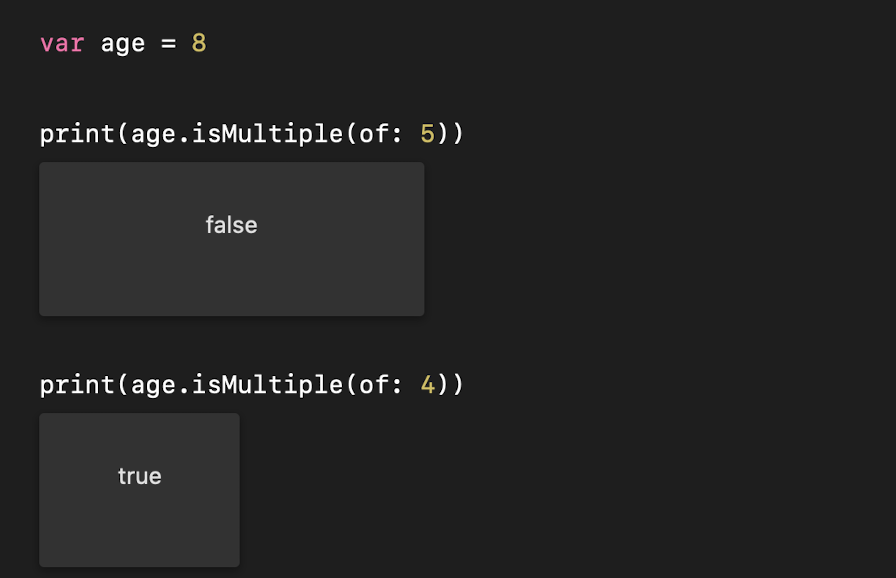
For example, talking about the 8 number value, we can call its isMultiple method, to check if the number is a multiple of another number:
A String value has another set of methods.
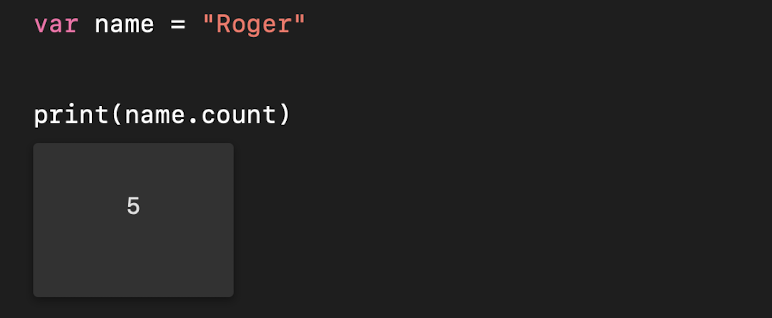
A type also has instance variables. For example the String type has the instance variable count, which gives you the number of characters in a string:
Swift has 3 different object types, which we’ll see in more detail later: classes, structs, and enums.
They are very different, but they have one thing in common: to any object type we can add methods, and to any value of any object type we can send messages.
Lessons in this unit:
| 0: | Introduction |
| 1: | Functions |
| 2: | Optionals and Nil |
| 3: | Enumerations |
| 4: | Structures |
| 5: | Classes |
| 6: | ▶︎ Objects |
| 7: | Protocols |
| 8: | Modules |