Join the AI Workshop and learn to build real-world apps with AI. A hands-on, practical program to level up your skills.
HTTP/3 is the newest “version” of HTTP.
It builds on the foundations laid by HTTP/2 but introduces significant changes, primarily by shifting from TCP (Transmission Control Protocol) to QUIC (Quick UDP Internet Connections) as the underlying transport protocol.
This means that HTTP/3 is based on a completely different tech stack compared to HTTP/2 and HTTP.
HTTP/3 offers several enhancements:
Reduced Latency: HTTP/3, by using QUIC, diminishes connection setup time. This means websites can load content quicker, especially noticeable on mobile networks or other high-latency environments.
Connection Resilience: With QUIC, if a user changes from one network to another (e.g., switching from Wi-Fi to 4G), the connection remains intact, leading to a smoother browsing experience.
Improved Congestion Control: QUIC has its congestion control mechanism, allowing for better data flow, especially in networks with packet loss.
Enhanced Security: While HTTP/2 encouraged the use of HTTPS, QUIC has built-in encryption, making browsing inherently more secure.
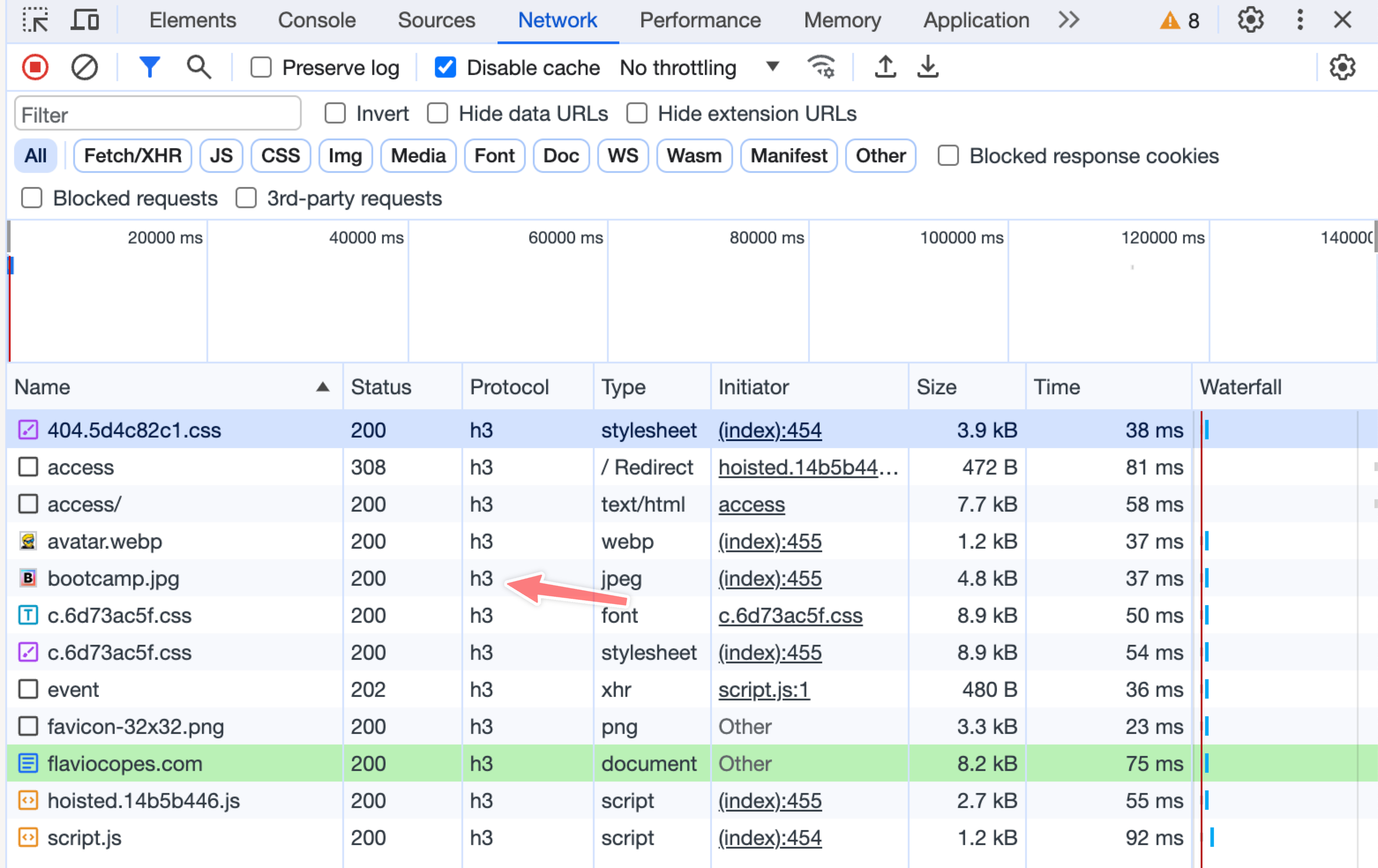
You can see the protocol version your website uses in the browser devtools, in the Network panel. h2 means HTTP/2 and h3 means HTTP/3: