Join the AI Workshop and learn to build real-world apps with AI. A hands-on, practical program to level up your skills.
A resistor is a conductor component that has a certain amount of resistance.
We have many different resistors, built with various materials and with different resistance values. For example in my set I currently have:
- 10Ω
- 220Ω
- 330Ω
- 1kΩ
- 2kΩ
- 5kΩ
- 10kΩ
- 100kΩ
- 1MΩ
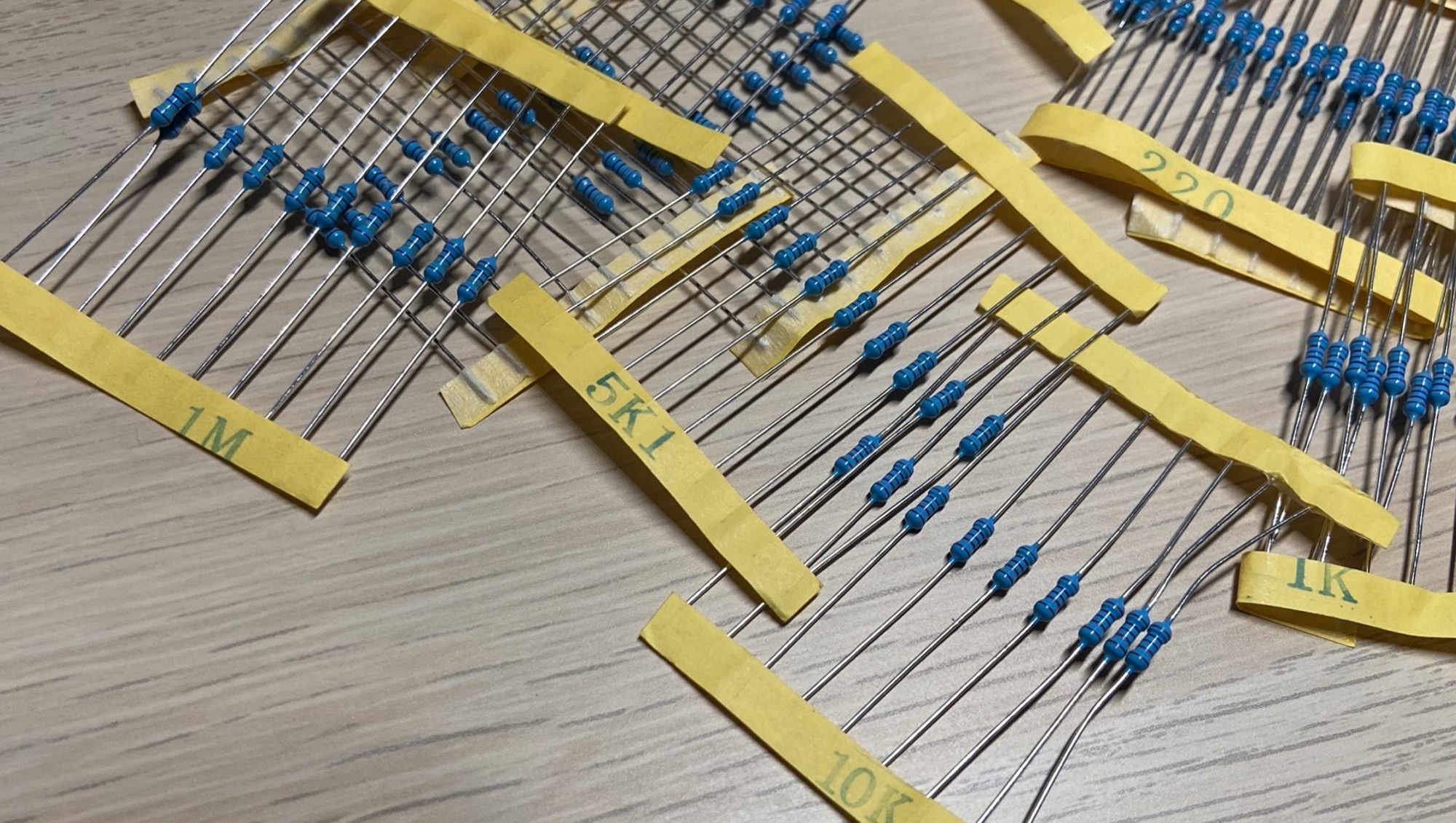
Each of those values has a different color combination, in order to let us identify the resistance value.
Reading the color is a skill on its own, and there are online calculators that help you with that, like this one.
Those above are fixed resistors, with a fixed resistance value.
Some other resistors which we’ll see later can let the users change their resistance (potentiometers), some change their resistance depending on the temperature (thermistors), light (photoresistors), and so on.
We’ve seen how a resistor can limit the amount of current flowing in a circuit in the lesson on the LED and battery circuit.
Lessons in this unit:
| 0: | Introduction |
| 1: | Breadboard Power Supply Module |
| 2: | ▶︎ Resistors |
| 3: | LEDs |
| 4: | RGB LEDs |
| 5: | Diodes |
| 6: | Buttons |
| 7: | Potentiometers |
| 8: | Buzzers |
| 9: | Servo Motors |
| 10: | Analog Joystick |
| 11: | The DHT11 temperature and humidity sensor |
| 12: | The 1602 LCD Display |